Ilya Sutskever ·OpenAI ·12 JUL 2017
Turn A Research Problem Into A Capital Problem
When you can't invent the answer, buy the conditions under which the answer becomes findable.
Reed Hastings ·Netflix ·18 SEP 2011
The Hastings Apology Is the Cleanest Public Wound-Closing in Modern CEO Communication
Five words. No throat-clearing. No qualifier. The apology arrives before the explanation, which is the only order that ever works.
Julie Sterling Osterling & Jonathan Bellack & Heidi O'brien & Chris Jansen & Brian Tomasette & Jason Sigalos ·Google ·29 SEP 2015
When Sales Can't Answer The Question, You Have A Strategy Problem
If your own sales team can't explain why you don't do the thing customers want, the market has already made the decision for you.
Purnima Kochikar & Tia Arzu & Paul Gennai & Jamie Rosenberg ·Google ·23 JUN 2018
When a Rival Skips Your Platform, Build the Data Case First
Before you negotiate, know exactly how much the other side needs you — and make sure your team does too.
Jack Dorsey ·Block, Inc. ·2 NOV 2023
Cap the Company Before You Cap the Customer
When the company is growing faster than the business, the fix is a hard ceiling, not a pep talk.
Mark Zuckerberg ·Facebook ·11 FEB 2013
Spot The Attack Vector Before It Reaches You
The most dangerous competitor isn't the one copying you today — it's the one entering through a door you left open.
Nick Clegg & Kang-Xing Jin ·Meta Platforms, Inc. ·27 AUG 2021
Regulatory Pressure Is a Budget Argument
When your policy team is writing your product roadmap, you've already lost the timing war.
Ed Baker & Jessica E. Lessin ·Uber ·26 DEC 2014
When Your Investor Becomes Your Biggest Competitor
The moment a board member starts leaving the room, the partnership is already over — the question is just who moves first.
Edward Cunningham & Sameer Samat & Jason Woloz & Jamie Rosenberg & Benjamin Poiesz & Mike Hochberg & Tian Lim & Dave Kleidermacher & Sebastian Porst & Hiroshi Lockheimer ·Google ·15 AUG 2018
When You Find a Rival's Bug, Slow Down Before You Act
A security vulnerability in a competitor's product is also a political and legal grenade — handle it before you pull the pin.
Purnima Kochikar & Jamie Rosenberg & Sidney Lee & Marc Shedroff ·Google ·10 JUN 2020
Grant the Favor Without Changing the Contract
The most powerful concession is one you give verbally and can quietly take back — without ever touching the written agreement.
Richard McCathron ·Hippo Holdings Inc. ·10 NOV 2022
Design Your Exposure Before the Disaster Hits
The best risk management happens months before the storm, not during it.
Reed Hastings & Netflix Leadership ·Netflix ·16 JUL 2020
Promote The Partner Who Already Runs Half The Company
Formalizing power someone already has is cheaper than losing them — and clearer for everyone watching.
Adrian Ong & Purnima Kochikar ·Google / Match Group ·19 JUN 2018
When Your Platform Partner Controls Your Churn Rate
The most dangerous contract clause isn't the price — it's the one that hands your retention mechanics to someone else.
Jim Giles & Eisar Lipkovitz & Jonathan Bellack & Payam Shodjai & Chris LaSala ·Google ·4 NOV 2017
Price the Commodity Cheap, Charge for the Unique
When your product bundles a commodity with something rare, price the commodity like a utility and hide your margin inside what only you can offer.
Tim Sweeney ·Epic Games ·17 JUL 2020
How to Signal a Legal Fight Before You File One
When a business dispute stops being about money and starts being about principle, the other side's lawyers are no longer the audience — the public and the courts are.
Jonathan Bellack ·Google LLC ·6 SEP 2016
Defend the Choke Point, Not the Product
When rivals attack your business model, your real moat is the one workflow they cannot route around.
Eugene W. Landy ·UMH Properties, Inc. ·13 MAR 2008
When Your Market Shrinks, Wait — Then Reload
The best time to be bullish on a market is right after everyone else has abandoned it.
David Ebersman & Dan Levy ·Meta (Facebook) ·16 APR 2012
After You Buy It, Don't Break It
The cost savings will still be there in a year. The momentum won't.
Neal Mohan ·Google LLC ·18 OCT 2010
Why Google Walled Off Its Own Ad Businesses
When you sit on both sides of a market, the appearance of fairness is a product feature — and you have to build the org chart to protect it.
Kento Sugiura ·Google ·23 AUG 2010
When Your Platform Is Threatened From Both Sides
When you sit in the middle of a market, your biggest danger isn't one competitor — it's being squeezed from every direction at once.
Scott Spencer & Nemo Semret & Eyal Manor & Craig DiNatali ·Google ·7 FEB 2011
When Your Product Has Gaps, Customers Tell You Exactly What to Build
A competitor winning your best customer is painful — but it's also the clearest product roadmap you'll ever get.
Tom Oliveri & Philipp Schindler & Hiroshi Lockheimer & John Giannandrea & Sundar Pichai ·Google ·26 AUG 2016
Never Run an Experiment You Can't Measure
If you can't measure it before you ship it, you're not experimenting — you're guessing with revenue.
Ilya Sutskever ·OpenAI ·12 JUL 2017
Compute Is the Constraint, Not Cleverness
If the bottleneck is hardware, the winner is whoever buys the most of it first.
Satya Nadella ·Microsoft ·13 OCT 2023
Nadella's Activision Memo Was Written for an Audience of One: the Press
Read this memo as a brief to Microsoft employees and it is bland. Read it as a brief to regulators, courts, and reporters and it is meticulous.
Elon Musk & Ilya Sutskever ·OpenAI ·18 FEB 2016
When A Rival Leaps Ahead, Change Your Cadence
A single alarming data point should reset how often your leadership team talks, not just what they talk about.
Eisar Lipkovitz & Jonathan Bellack ·Google LLC ·4 JAN 2017
Control the Decision Layer, Win the Market
Whoever owns the decision-maker in a stack owns the economics — everything else is just inventory.
[REDACTED] & Justin Osofsky & Mark Zuckerberg & Javier Olivan & David Fischer & Dan Rose & Mike Vernal & Mike Schroepfer ·Meta/Facebook ·10 JAN 2013
Deny Competitors Fuel From Your Platform
When a small revenue line helps a rival build a business that could replace you, the trade isn't close.
Don ·Google ·14 MAR 2023
Bundle Deals Across Divisions to Save a Weak Position
When one business unit can't justify the check alone, stack the strategic value across the whole company — or lose the partner entirely.
Paul Gennai & Atul Kumar & Samer Sayigh & Jamie Rosenberg & Alexi Douvas & Shafiq Ahmed & Mike Petrillo ·Google ·26 MAR 2019
Hide The Price By Bundling It
When one number scares a partner, wrap it inside a bigger one they can't easily unpack.
Apple Legal Department ·Apple Inc. ·15 SEP 2020
Reframe Your Price as a Bundle, Not a Tax
When someone attacks your fee, don't defend the fee — redefine what they're actually buying.
Dario Amodei & Emil Michael ·Anthropic ·26 FEB 2026
How to Walk Away Without Burning the Bridge
When the other side rewrites your redlines into meaningless words, name the trick precisely — then keep the door open.
Richard McCathron ·Hippo Holdings Inc. ·8 AUG 2024
Fix the risk profile first, then grow
The best time to prove your risk controls work is when the whole industry is bleeding — and you're not.
Brandon Barras & Sameer Samat & Kirsten Rasanen ·Google ·27 JUN 2017
Why Holding Price Is Really About Holding Precedent
The real cost of a discount isn't the revenue you lose — it's the pricing power you can never rebuild.
Jonathan Bellack & Alex Shellhammer & Suzanne Blackburn & Lara O'Reilly ·Google ·12 JUL 2016
When Your Product Rules Create Competitive Moats, Own It
The most revealing strategy documents are the ones written in real time, when someone is still figuring out what to say publicly about rules they set privately.
Denelle Dixon-Thayer ·Mozilla ·4 NOV 2014
When to Pick the Risky Partner Over the Safe One
Sometimes the best deal isn't the biggest check — it's the one that buys you back your independence.
Joe Berchtold & Michael Wichser ·Live Nation/Ticketmaster ·12 AUG 2022
When You Already Own the Market, Your Deal Goal Changes
When you already have most of the volume, the only deal worth signing is one that locks in the future and protects what you have.
Neal Mohan ·Google LLC ·23 MAR 2009
Don't Bleed an Acquisition to Death by a Thousand Cuts
An acquired business is worth more than its P&L — cut it like a standalone and you destroy the very reason you bought it.
Andy Jassy ·Amazon ·11 APR 2024
How Margin Expansion and New S-Curves Compound Together
When your core business gets cheaper to run, every new bet you place gets cheaper to fund.
Sam Altman ·OpenAI ·31 AUG 2018
Structure Your Cap Table Around Your Mission, Not the Reverse
If your mission truly comes first, your legal structure has to prove it — even to yourself.
Square Investor Relations Team ·Square, Inc. ·1 NOV 2016
Win Bigger Customers Without Cutting Your Price
The strongest growth signal in this letter isn't revenue — it's that larger sellers are choosing Square on product merit, not discounts.
Andy Jassy ·Amazon ·9 APR 2026
Progress Is a Squiggly Line, Not a Straight One
Durable companies don't bet on one straight line — they build the muscle to zig, zag, and start over without losing momentum.
Jack Dorsey & Sarah Friar ·Square, Inc. ·3 AUG 2016
How Square Turned a Payment Tool Into a Business Platform
The real moat isn't the hardware — it's every product a seller adopts after the first swipe.
Tim Sweeney & Hiroshi Lockheimer ·Google ·22 JUL 2020
Why Platforms Refuse the 'Just One Exception' Ask
The moment a platform grants one developer a private deal, it loses the argument for every other developer.
Mark Zuckerberg ·Facebook, Inc. ·28 FEB 2012
"It is better to buy than compete." The 60-Word Email That Cost Meta Billions in Discovery
Eight years later, this paragraph would be sitting in front of a House subcommittee, a federal judge, and the Federal Trade Commission.
Elon Musk & Andrej Karpathy ·OpenAI ·1 FEB 2018
If You Can't Win Open, Find a Cash Cow
Open research without a profit engine isn't idealism — it's free R&D for whoever has the bigger bank account.
Warren Buffett ·Berkshire Hathaway ·1 MAR 2010
Hold Expensive Cash So You Can Be the Buyer in a Crisis
Liquidity is a strategic weapon disguised as a boring balance sheet item — its real return shows up only when everyone else runs out.
Jim Kolotouros & Jamie Rosenberg & Hiroshi Lockheimer & Sameer Samat ·Google ·30 MAY 2019
Bundle Your Assets Before A Partner Unbundles You
When one partner controls half your revenue, stop negotiating deal by deal — treat every dollar you send them as one connected bet.
Erin Crosby & Jim Kolotouros & Sameer Samat & Jamie Rosenberg & Paul Gennai & Hiroshi Lockheimer ·Google ·19 JUN 2019
When Your Partner Might Undercut Your Price, Pay Differently
The real negotiation isn't about money — it's about locking in the business model before you write any check.
Apple Legal Department ·Apple Inc. ·4 SEP 2020
Reframe the Fight: You're Not a Toll Booth, You're a Bundle
When someone attacks your pricing, don't defend the price — redefine what they're actually paying for.
Elon Musk & Ilya Sutskever ·OpenAI ·13 SEP 2017
Design Board Math Before You Need It
Control isn't a feeling — it's a seat count, and smart founders draw the arithmetic before the fight, not during it.
Anthony Levandowski & Suzy Sammons ·Uber ·28 MAR 2017
How to Split Message Control When Two Crises Hit at Once
When two fires break out at once, the fastest move is to assign one firefighter to each — and make the split explicit before the meeting starts.
Jonathan Bellack ·Google ·17 OCT 2016
Ideas Are Cheap; Buildable Plans Win Reviews
Senior leaders are paid not for the insight that points at action, but for the plan a hundred people can actually execute.
Anna Kartasheva ·Google ·4 JUN 2020
Lock The Default, Own The Front Door
When you can't win the device, win every doorway on it.
Margaret Stewart & Mark Zuckerberg & Sue Young & Nick Clegg & Monika Bickert & Naomi Gleit & Andy O'Connell ·Meta/Facebook ·12 MAY 2020
The Burden-of-Proof Trap in Product Decisions
When you require proof of harm before acting, you've already decided in favor of the risk.
Michael Murphy & Shafiq Ahmed & Philipp Schindler & Sridhar Ramaswamy ·Google ·21 JUL 2018
Pay to Protect the Price, Not the Product
Sometimes you overpay one customer so you never have to renegotiate with the next hundred.
Neal Mohan ·Google LLC ·11 OCT 2010
Buy the Competitor to Buy Yourself Time
Sometimes you acquire a rival not to use what they built, but to stop the clock while you fix what you have.
Johan Heurlin & Lawrence Koh & Jamie Rosenberg ·Google ·27 MAR 2019
When a Big Partner Asks for a Discount, Reframe the Deal
The smartest concessions look like co-investment, not subsidies — same money, very different risk.
Roku Management ·Roku ·21 FEB 2019
Build the Audience First, Then Sell the Audience
The platform that wins the eyeballs first will collect the ad dollars second — Roku is betting the sequence matters.
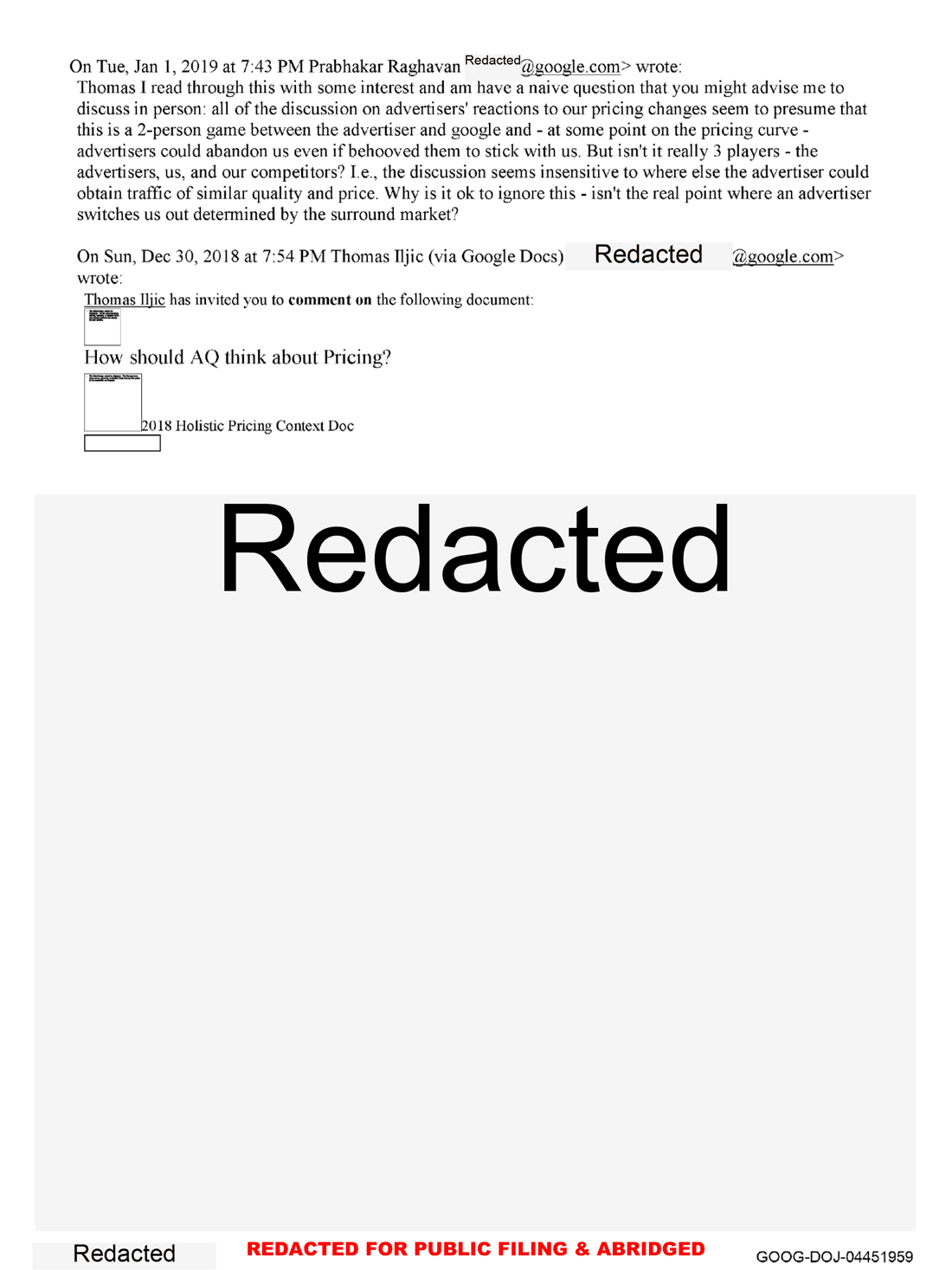
Prabhakar Raghavan ·Google ·20 JUN 2019
Measure What Rivals Are Quietly Stealing From You
If a competitor might be eating your lunch one bite at a time, build the instruments to see the bites — don't settle for gut feel.
Raymond Endres & Alex Schultz & Javier Olivan ·Meta/Facebook ·22 FEB 2014
When Winning Removes Your Team's Reason to Fight
If you build a team's identity around beating a rival, buying that rival creates a morale crisis, not a celebration.
DSP Group Board of Directors ·DSP Group Inc ·11 MAR 2013
When a 10% Shareholder Wants to Run Your Company
Control of the boardroom is control of strategy — and some investors know exactly how to take it one committee at a time.
Mark Zuckerberg ·Meta Platforms, Inc. ·11 FEB 2012
When Your Original Thesis Is Wrong, Pay To Fix It Fast
If a small competitor has already won the use case your future depends on, the cheapest option is usually to buy them — before the market figures out how valuable they are.
[redacted] ·Apple ·8 JUN 2015
When You Favor One Product, Your Ecosystem Notices
Unequal investment across your own platform is a message — and your most engaged users will read it loud and clear.
Travis Kalanick ·Uber ·22 OCT 2013
The Kalanick Miami Memo Is What Happens When a Leader Writes Like the Email Is Private
The memo's existence is more instructive than its contents. The contents are the symptom; the existence is the diagnosis.
Amy Hood ·Microsoft ·26 JUN 2023
Buy Your Way Off a Shrinking Island
When your platform is losing relevance, don't defend it — buy the assets that live on the platforms that are winning.
DoorDash Leadership ·DoorDash ·15 FEB 2024
After Land Grab, Switch To Operating Discipline
Growth and efficiency aren't opposites — they're phases. Knowing which phase you're in is the job.
Jonathan Bellack ·Google LLC ·16 JUN 2011
When Your Partners Start Stealing Your Customers
When 60% of your paying customers are already using a competitor's tool inside your own platform, you don't have a partnership problem — you have a survival problem.
Dan Jackson & Colin Smith & Hiroshi Lockheimer ·Google ·9 JAN 2020
Manage the Headlines Before You Send the Email
Internal words become external weapons — pick them like a reporter will read them, because eventually one will.
Greg Brockman ·OpenAI ·31 JAN 2018
Turn Your Mission Into A Moat
When you can't outspend competitors, out-trust them — moral high ground is a strategic asset, not a slogan.
Warren Buffett ·Berkshire Hathaway, Inc. ·27 FEB 2009
Buffett's 2008 Letter Spends Three Pages Telling Shareholders What He Got Wrong
Buffett doesn't apologize for the loss. He apologizes for the analysis. Those are different things and most CEOs conflate them.
Travis Kalanick & David Drummond ·Uber / Google ·7 MAR 2015
When Your Partner Stops Taking Meetings, Believe the Silence
A calendar tells you more about a partnership than any press release ever will.
Lawrence Koh ·Google ·13 FEB 2020
Stop the Bleeding First, Then Sign the Contract
When a partner is about to walk, buy the pause first and negotiate the terms later.
Tim Leiweke & Michael Rapino ·Live Nation Entertainment / Ticketmaster ·27 FEB 2021
When a Rival's Big Number Actually Means Nothing
A competitor's headline offer can look devastating until you realize it depends on an approval that will never come.
Mike Petrillo & Jamie Rosenberg ·Google ·3 JUN 2016
How to Preempt a Competitor Without Boxing Yourself In
A vague public commitment can steal credit for an idea while letting your rival define the price.
Boeing engineering staff ·Boeing ·14 DEC 2015
When Engineers Ask 'Are We Vulnerable?' and Nobody Stops the Clock
The most dangerous moment in any engineering process is when a serious risk question gets answered with another question.
Jamie Rosenberg & Donald Harrison & Michael Murphy ·Google ·11 JUL 2018
When a Competitor Bypasses You, Buy Them Back In
The fastest way to defend a platform is to make leaving it more expensive than staying.
Jocelyn Goldfein ·Meta/Facebook ·13 SEP 2011
When Your Boss Wants Speed, Not Capacity
A good manager translates a boss's impatience into a plan — without abandoning the long-term build.
Sarah Karam & Purnima Kochikar & Brandon Barras & Adrian Ong ·Google ·20 JUN 2018
When a partner complains, ask why before you respond
The loudest complaint is rarely about the thing being complained about.
Jonathan Bellack ·Google ·20 JAN 2017
When a Big Customer Fires You, Sell Value Not Price
When a customer pulls the plug, you have one shot — show them what they're losing, not just what you'll discount.
David Drummond ·Google ·23 MAR 2007
When a Rival Bids, Your Build Plan Becomes a Buy Decision
A build-it-yourself plan is only valid until a competitor's checkbook makes the timeline irrelevant.
Elon Musk & Ilya Sutskever ·OpenAI ·20 SEP 2017
When Funding Becomes Leverage, Trust Becomes the Real Asset
The moment your funder's leverage looks like a path to absolute control, your co-founders stop building and start negotiating their exit.
Mark Zuckerberg & Elon Musk ·Meta, Tesla/X ·13 DEC 2024
Warn a rival first, then ask for the meeting
The most valuable currency between competitors isn't money — it's a heads-up before the news breaks.
Nate Morgan ·Google ·19 OCT 2019
When Your Data Proves You Right, Use It Fast
The moment you have data that proves your recommendation was correct, stop being polite — escalate immediately and make the case with numbers.
Jonathan Bellack ·Google LLC ·29 OCT 2016
Measure The Market You Actually Compete In
If you measure the whole market instead of the slice customers can actually move, you'll misjudge both your power and your problem.
Tim Sweeney ·Epic Games ·13 AUG 2020
How to Pick a Fight You Planned to Win
When you deliberately break a powerful partner's rules, the letter you send isn't a negotiation — it's the opening statement of a lawsuit you've already prepared.
Neal Mohan & Scott Spencer & Joerg Heilig ·Google LLC ·21 APR 2009
Take the Small Competitor With the Right Shape Seriously
Scale wins fights, but a competitor copying your structure can become a real threat long before they look like one on paper.
Drew Bradstock ·Google LLC ·22 JUL 2015
Don't Give Away Your Best Weapon For Free
When competitors find a cheap workaround to your premium product, the real question isn't whether to fight it — it's whether your pricing power survives if you don't.
Peter Stern & Matt Fischer & Philip Schiller & Carson Oliver & Adrian Ong ·Apple Inc. / Match Group ·28 JAN 2019
How to Negotiate When You're the Whale but Not the Favorite
When you're a top customer paying a rack-rate meant for someone else, quantify the mismatch and name the comparable — don't complain, benchmark.
Sam Altman ·OpenAI ·6 MAR 2019
Design The Structure Before You Need The Money
When your mission and your capital needs collide, invent the vehicle first — then go raise.
Tony Xu ·DoorDash ·18 FEB 2026
Build the Hard Side First, Then the Obvious Side
The product your customer sees is rarely the product that decides whether you win.
Andy Hewitt & Brian Smith & Colin Lewis & Jenny Heifetz Henault ·Live Nation Entertainment ·23 MAR 2021
Paying for Exclusion: When Access Is the Real Asset
The most valuable thing you can own isn't the venue — it's the right to keep your competitor out of it.
Chip Hall & Chris LaSala & Gargi Sur & Max Loubser & Jonathan Bellack & Roberto Ruju & Barbara B. Piermont & Thomas Jacques & George Levitte ·Google ·4 JAN 2017
Your KPI Drives Behavior — Choose It Like a Strategy
The metric you pick isn't just how you measure success — it's the strategy itself.
Shanna Velez & Mike Marchak & Purnima Kochikar & Alyssa Ablao & Josh Kim & Randy Gelber ·Google ·15 DEC 2021
Discounts Are Cheaper Than Exceptions to Your Pricing Rule
When you can't grant a carveout, invent a program — same economics, but the rule stays intact.
Jamie Rosenberg & Colin Smith & Sameer Samat & Hiroshi Lockheimer ·Google ·8 AUG 2018
When A Big Customer Leaves, Defend The Ones Who Stayed
When a defector proves your platform isn't the only option, your first job is to make staying feel obviously worth it.
Tim Sweeney ·Epic Games ·30 JUN 2020
How to Frame a Demand as a Favor to Customers
When you can't beat a gatekeeper on their terms, reframe the fight as being about their customers, not you.
Purnima Kochikar & Tim Sweeney & Donald Harrison & Hiroshi Lockheimer ·Google / Epic Games ·10 DEC 2019
Frame Your Fight as an Industry Problem, Not a Favor
When you're picking a fight with a giant, don't ask for an exception — demand a rule change, and make sure everyone is watching.
Neal Mohan & David Rosenblatt & Marc Schraer & Sean Downey & Andrew Rutledge & Ruth Kirschner ·Google ·13 FEB 2009
Don't Compete on Price When You Own the Platform
When a rival slashes prices out of desperation, the answer isn't matching them — it's reminding your customers what game you're actually playing.
Jonathan Bellack ·Google ·10 MAY 2018
Owning the Pipe Is Worth More Than Renting It
Every dollar that flows through someone else's exchange is a dollar where you don't set the toll — and Bellack's math shows just how big that toll can be.
Elon Musk & Greg Brockman & Ilya Sutskever & Jared Birchall ·OpenAI ·21 JUL 2017
Plan the Exit Before You Need It: Staging a Mission
The most important strategic decision isn't where you start — it's knowing which structure you'll need next, and when to trigger the shift.
Richard McCathron ·Hippo Holdings Inc. ·7 MAY 2025
How to Shrink a Portfolio Before You Grow It
The best time to expand is right after you've finished cutting — not before.
Eddy Cue ·Apple ·10 JAN 2013
Turn a Competitor's Weakness Into Your Positioning Strategy
When a rival's business model forces them to behave in ways users dislike, that tension is your product opportunity.
Karen Aviram Beatty & Lawrence Koh ·Google ·11 DEC 2019
Bundling Deals Can Backfire When Your Counterparty Wants Simplicity
When you stack asks to justify a payment, the other side sees complexity — and offers you a simpler exit.
Michael Rapino & David Marcus & Tara Traub & Mark Yovich & Michael Wichser ·Live Nation Entertainment / Ticketmaster ·22 AUG 2022
When a Customer Calls Your Fee Structure a Problem, Listen Fast
The moment a client's manager whispers 'double dipping,' you have minutes to build a clear answer — or you have a narrative crisis.
Eileen Naughton ·Google ·19 MAY 2008
A Green Light With Guardrails: How Smart Leaders Approve Risky Ideas
The most valuable approval you can get isn't a blank check — it's a conditional yes that tells you exactly where the limits are.
Andy Jassy ·Amazon ·10 APR 2025
Ask Why Until The Locked Doors Open
Most companies optimize inside the room they're standing in; the best ones keep asking why the door is locked.
Jeff Shardell ·Google ·4 JUN 2007
Price Your Distribution Power Honestly
When a partner asks for the same price on a worse deal, the right answer starts with naming what you're actually buying.
Michael Murphy ·Google ·17 MAR 2020
When to Pay Less and Still Keep the Shelf Space
Sometimes the smartest negotiation move is paying your partners less — if you can redirect that money to win the customers who matter most.
Neal Mohan & Jonathan Bellack & Brad Bender & Ari Paparo ·Google LLC ·25 JUN 2009
Control Who Builds On Your Platform Before You Open The Doors
Once you open a platform to everyone, you lose the right to choose who gets to compete with you on it — so pick your moment carefully.
Elon Musk ·OpenAI ·28 JUN 2017
How to Turn a Partner's Asset Into Your Competitive Weapon
The fastest way to build a moat is to make someone else's resources do the work — before your rivals think to ask.
Tim Sweeney & Jamie Rosenberg ·Epic Games / Google ·22 JUN 2018
Frame Your Fight as Principle, Not Price
When you refuse a deal, refuse the whole game — not just the terms on the table.
Neal Mohan ·Google ·31 JAN 2009
Open Platforms Stop Where Your Profit Starts
Be open to partners — until the partner's product replaces the part of yours that actually makes money.
Purnima Kochikar & Sarah Karam & Brandon Barras & Paul Feng & Sameer Samat ·Google ·23 JUL 2019
When Your Customer Brings Demand, They Hold the Leverage
If a user was already searching for your product before arriving at the platform, the platform didn't create that demand — and both sides know it.
Neal Mohan ·Google LLC ·19 OCT 2010
Admit the Threat You Missed, Then Change Course
Strategy reviews are worthless if leaders won't say out loud what they got wrong.
Netflix Investor Relations ·Netflix ·21 APR 2014
How To Frame Competition When You're Outgunned
When you face bigger rivals on every side, define the game by the two things only you can do well.
Richard McCathron ·Hippo Holdings Inc. ·6 MAR 2024
Shrink the Risk Before You Chase the Growth
Before going on offense, fix the math on the losses you can actually control.
[redacted developer] ·Apple ·23 AUG 2015
When Your Platform Changes the Rules Mid-Game
When a platform controls your distribution, their algorithm changes are your revenue changes — full stop.
Sam Bankman-Fried & Ryan Pinder & Daniel Friedberg ·FTX Trading Ltd. ·10 NOV 2022
In a Crisis, Pick One Audience And Protect Them First
When you can't save everyone, be honest about who you're choosing to save first — and expect the rest to notice.
Purnima Kochikar & Jamie Rosenberg & Bob Meese ·Google ·3 AUG 2013
The Real Moat Is Distribution, Not Billing
Developers won't pay you 30% to process a credit card. They'll pay it to reach customers.
Kate Plikus ·Microsoft ·2 OCT 2018
Why Scale Is The Real Moat In Ad Auctions
In ad markets, scale isn't just an advantage — it's the price of admission to compete at all.
Purnima Kochikar & Jamie Rosenberg ·Google ·19 JUL 2018
Choreograph the Meeting Before You Walk In
Great negotiators don't just prepare arguments — they stage-manage what the other side hears, when, and from whom.
Sam Altman & Elon Musk ·OpenAI ·18 FEB 2023
How to Handle a Powerful Critic You Still Need
When a former ally attacks you in public, don't defend — pivot to asking what they'd do instead.
Joan Braddi & Sundar Pichai & Sergey Brin & Jonathan Rosenberg ·Google ·7 JUN 2007
Don't Pay for Customers You Already Own
If your partner brings no real users to the deal, they aren't a partner — they're a toll booth.
Kirsten Rasanen & Sameer Samat & Wilson White & Paul Feng ·Google ·17 OCT 2017
Preview Bad News Before You Ship It
When you're about to close a door on a big partner, walking through it in person costs you nothing and buys you information you can't get any other way.
Jag Duggal ·Google ·6 APR 2010
Own Both Sides of the Market or Someone Else Will
If you control the plumbing on both the buyer and seller side, you don't just win transactions — you define the rules of the game.
Kirsten Rasanen ·Google ·7 FEB 2018
When Your Biggest Partners Refuse Your Terms, Listen
A 10% discount can't buy compliance when the real objection is losing control of the customer.
Richard McCathron ·Hippo Holdings Inc. ·6 AUG 2025
Sell the asset, keep the distribution, triple your reach
The smartest asset sale isn't an exit — it's a trade: cash plus a bigger channel.
Chris Cox ·Meta/Facebook ·22 FEB 2011
Unbundle Before A Competitor Unbundles You
When a small competitor breaks out a feature from your app and it explodes, that's not a threat to swat — it's a signal to copy.
Michal D. Cann & John L. (Jack) Wagner ·WASHINGTON BANKING CO ·21 AUG 2008
Walk Away Early: When a Bad Deal Protects Your Moat
Knowing when to kill a deal is as valuable as knowing when to sign one.
Jeff Bezos ·Amazon.com, Inc. ·30 MAR 1998
Bezos Built Amazon by Refusing to Define Success in Quarters
The discipline isn't in what Bezos optimized for. It's in what he refused to apologize for not optimizing.
Julie Sterling & Jonathan Bellack & Drew Bradstock & Alex Shellhammer ·Google ·11 NOV 2015
When Your Sales Team Can't Explain a Gap, You Have a Strategy Problem
If your frontline can't answer the obvious question, the problem isn't training — it's that you haven't decided what you actually believe.
Matt Fischer ·Apple Inc. ·21 AUG 2018
When Your Pricing Faces Pushback, Negotiate Before You Lose the Deal
The moment your partners consistently refuse your terms, you have two choices: lose them or adapt — and waiting too long to decide is its own decision.
Tony Xu ·DoorDash ·11 FEB 2025
Spend Big Only After You See Product-Market Fit
Profit and growth aren't opposites when capital follows evidence, not enthusiasm.
Scott Spencer & Jonathan Bellack & Scott Cunningham ·Google ·11 OCT 2015
When Your Own Plumbing Becomes The Problem
If your product's integration advantage forces the market to build ugly workarounds, the workarounds eventually become the market.
Steven E. Fass & David T. Foy ·White Mountains Insurance Group Ltd ·10 APR 2006
When Your Models Fail, Own It Fast
Risk models are tools, not oracles — and the leaders who survive bad years are the ones who say so out loud.
Richard McCathron ·Hippo Holdings Inc. ·2 MAY 2024
Shrink to Grow: How Hippo Traded Revenue for Resilience
Deliberately slowing growth in the short term can be the fastest way to reach sustainable growth — if you're cutting the right risks, not the right customers.
Michael Rapino & Mark Campana & Irving Azoff & Peter Luukko & Eric Gardner & Brad Wavra ·Live Nation / Ticketmaster ·18 APR 2019
When Two Teams Both Have Leverage, You Need One Voice
If your sales team and your operations team are both hitting the same customer with different asks, you don't have a strategy — you have a turf war.
Marc Theermann ·Google ·10 SEP 2012
Use Your Hot Product to Lock Customers Into Your Platform
When you have a product everyone wants, the real question isn't how to sell it — it's what else you can pull through the door with it.
Neal Mohan & Eric Rosenblum ·Google ·20 AUG 2010
Keep New Businesses Focused, Not Merged
When a young business is fighting to establish itself, the worst thing you can do is bury it inside a bigger org chart.
Ruth Porat & Jamie Rosenberg ·Google ·21 JUL 2017
Conditional Payments: How Google Kept Samsung Honest on Defaults
The real deal isn't the revenue share — it's what you have to give up to earn it.
[REDACTED] ·Meta ·8 NOV 2016
Pick One Number, Fund the Teams That Move It
A real priority has one metric, a budget, and a bounty for anyone who signs up to move it.
Neal Mohan & Joan Braddi ·Google ·3 SEP 2008
Build the Pipeline First, Then Fill It With Revenue
The smartest strategy documents don't just show where you're winning — they name exactly where the work isn't done yet.
Jamie Rosenberg & Tian Lim & Erin Crosby & Sameer Samat ·Google ·7 FEB 2019
Neutralize a Rival by Absorbing Their Ambition
When a partner tries to build a competing store, don't fight the ambition — offer to power it.
Karina Newton & Monika Bickert & Elisabeth Diana ·Meta/Instagram ·10 OCT 2019
When You Can't Defend Your Product, Stop Selling It
The moment your own team says 'we are in a very bad place defending this,' that's not a PR problem — it's a product problem.
Jonathan Bellack & Eisar Lipkovitz & Brad Bender & Paul Muret & Danielle Romain ·Google LLC ·10 NOV 2016
When to Cut Price for Strategy, Not for Sales
A price cut with no strategic story is just margin you gave away for nothing.
Jim Giles & Eisar Lipkovitz & Jonathan Bellack & Payam Shodjai & Chris LaSala ·Google LLC ·4 NOV 2017
When Your Product Commoditizes, Bundle or Bleed
If the market is racing your margin to zero, either bundle your way out of the fight or pick which piece you're willing to give away first.
Woojin Kim & Drew Bradstock & Allan Livingston ·Google ·26 JUL 2012
When You Lock Your Own Team Out of the Market
If your internal product can only win by being kept on a leash, you haven't built a strong product — you've just built a wall.
Ted Sarandos & Greg Peters & Spence Neumann & Spencer Wang ·Netflix ·18 OCT 2023
How Netflix Turned Content Spending Into a Flywheel
If you want to justify a massive cost center, show how it drives margin expansion at the same time — then the spending becomes the strategy.
Sameer Samat & Jamie Rosenberg ·Google ·8 JUN 2016
Being First Matters Less Than Being Seen First
You can do the work earlier and still lose the story if you never tell it.
Jamie Rosenberg & Purnima Kochikar ·Google ·27 AUG 2013
What You Won't Put In Writing Tells You Everything
If you can't publish the terms, don't pretend they're standard — say plainly that this deal is bespoke.
Kirsten Rasanen & Samer Sayigh ·Google ·21 DEC 2023
When Fear Of Noise Beats The Better Plan
The best-designed policy loses to the loudest possible critic — until you honestly weigh the cost of doing nothing.
Eisar Lipkovitz & Jonathan Bellack & Sagnik Nandy & Chris Harris ·Google ·21 JUL 2017
Use Your Buy-Side Muscle to Punish Sell-Side Behavior You Dislike
When you own both sides of a market, you can turn a policy fight into a purchasing decision.
Mark Zuckerberg & [REDACTED] ·Meta (Facebook) ·9 APR 2012
Buy The Threat Before It Becomes The Competitor
When a small player is beating you on a new behavior, acquisition can be cheaper than the fight.
Apple Legal Department ·Apple Inc. ·8 SEP 2020
Reframe Your Product as a Bundle, Not a Fee
When someone attacks your price, don't defend the price — redefine what they're actually paying for.
Ilya Sutskever ·OpenAI ·13 SEP 2017
How to Split Control When Everyone Brings Something Different
In a founding negotiation, spelling out who decides what — in writing — is more valuable than any equity number.
Sameer Samat & Laura Willis & Hiroshi Lockheimer ·Google ·18 OCT 2017
When You Cut Prices, Control the Volume of the Announcement
A price cut only helps you if it doesn't teach the market that your old price was negotiable.
Zachary Goldberg ·Google ·18 FEB 2011
When Competitors Force You to Cannibalize Yourself
If rivals are already selling what you fear to build, the only thing worse than disrupting your own business is letting them do it for you.
Kirsten Rasanen & Jamie Rosenberg & Sameer Samat ·Google ·18 SEP 2017
Pre-Sell The Policy Before You Announce It
When a policy will anger your biggest partners, negotiate them into it privately before the world hears about it.
Jonathan Bellack & Aparna Pappu & Jim Giles & Chris LaSala & Josh Cohen & Max Loubser & Laurent Cordier & Justin Pang ·Google ·1 FEB 2017
When Your Moat Shrinks, Know Exactly What You're Still Worth
A dominant market position isn't the same as a defensible price — and knowing the difference before your customer does is the whole game.
Jonathan Bellack & Assaf Grabinsky & Nitish Korula & Drew Bradstock & Vahab Mirrokni & Martin Blais ·Google ·4 AUG 2015
When Your Platform Rules Create the Competition You Fear
When your own pricing structure drives customers to build workarounds, the real threat isn't the workaround — it's the rule.
Elon Musk & Andrej Karpathy ·OpenAI ·1 FEB 2018
Open Research Without Scale Feeds Your Competitor
If you can't match a giant's scale, publishing your best ideas is a subsidy to them, not a strategy against them.